The system analyses and prepares
- Collects and updates information from public sources.
- Analyses signals, records confidence in hypotheses and updates priorities.
- Drafts correspondence, organises replies and suggests next actions.

ExitSignal is an original system supporting the search for businesses to acquire and the work behind a potential transaction. It combines public data, AI analysis, indicative valuations and CRM. Its first application is the Polish accounting firm market.
The dashboard is operational, while the assumptions and usefulness of the workflow are being tested in practice. The project has no documented transaction results yet.
ExitSignal is an internal tool. A project demonstration without confidential data is available on request.
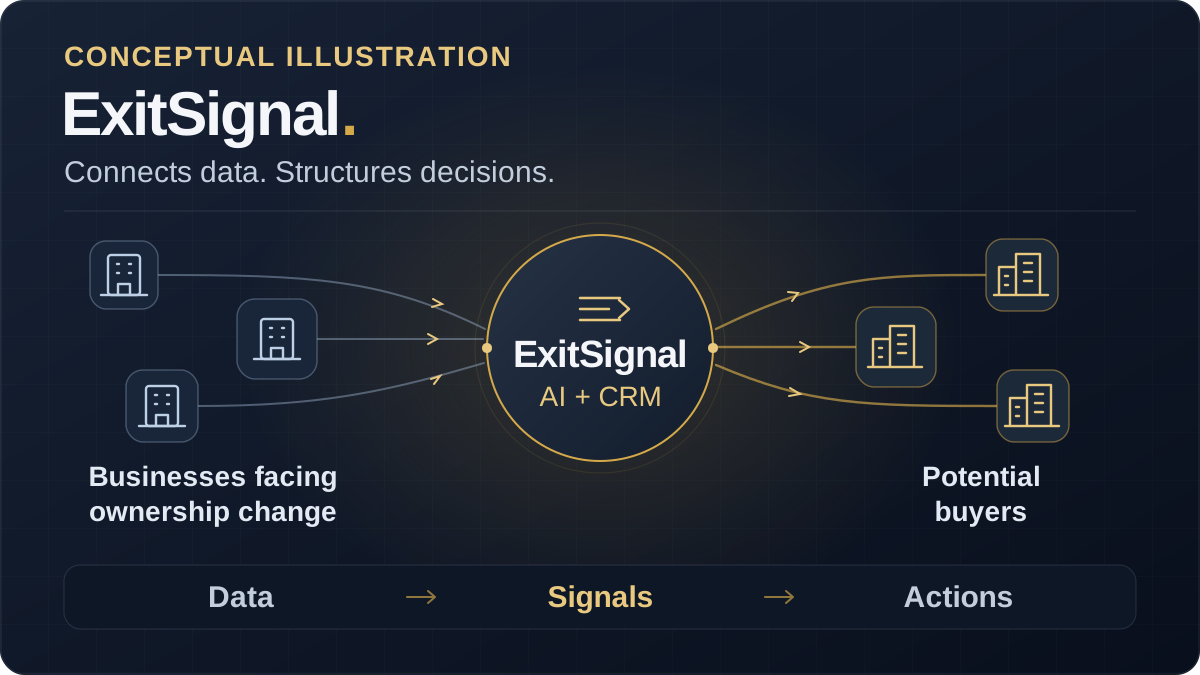
In the fragmented accounting firm market, owners considering succession and potential buyers have no straightforward way to find each other. ExitSignal was built around this problem: how to research the market, assess a potential match and take a case from the first piece of information through successive stages of discussion.
Translate a market problem into clear system tasks: identify businesses worth reviewing, explain their priority and prepare the next step. Usefulness in the business process is the guiding principle.
Connect public sources, a data model, signal assessment, indicative valuations and CRM. Each stage supplies the information needed by the next, preserving its provenance and level of confidence.
A PWA dashboard designed for a single operator and accessible on a phone. AI roles support analysis and task organisation, while the interface connects information with a case, its history and its next action.
The working dashboard connects market research with transaction workflow management. The project demonstrates the path from a market problem to a product: a data model, working rules, a division of responsibilities between AI and people, and an operator interface.
Each stage answers a different question for the operator: what do we know about the market, what deserves a closer look and how should we prepare the next step?
Information from registers and financial statements, with its sources identified.
A sector-specific database and structured company profiles that provide the starting point for analysis.
Succession hypotheses and a queue of cases to assess, taking data confidence into account.
An estimated value range based on financial statements, providing a starting point for further verification.
Information summaries and correspondence drafts for the person managing contact.
CRM, a record of discussions, potential matching and support for subsequent stages of the transaction process.
Six AI roles share the analytical and operational tasks. Some update data and assessments; others prepare materials and recommendations for the operator.
Information provenance and confidence are part of the data model. Recommendations therefore have context, and uncertainty stays visible to the person making the decision.
The work queue is designed to help select cases that matter to the business. Assessing opportunities and information reliability serves the next action, not database growth for its own sake.
The dashboard connects analysis with day-to-day case management. Desktop and phone access, together with suggested next actions, help the operator manage the process in one environment.
Data collection, provenance and case management are separated from market-specific criteria. This provides a foundation for adapting the solution to other sectors. Each application still requires its own sources, assessment criteria and business validation.
Opens WhatsApp with a draft. You review and send the message yourself.